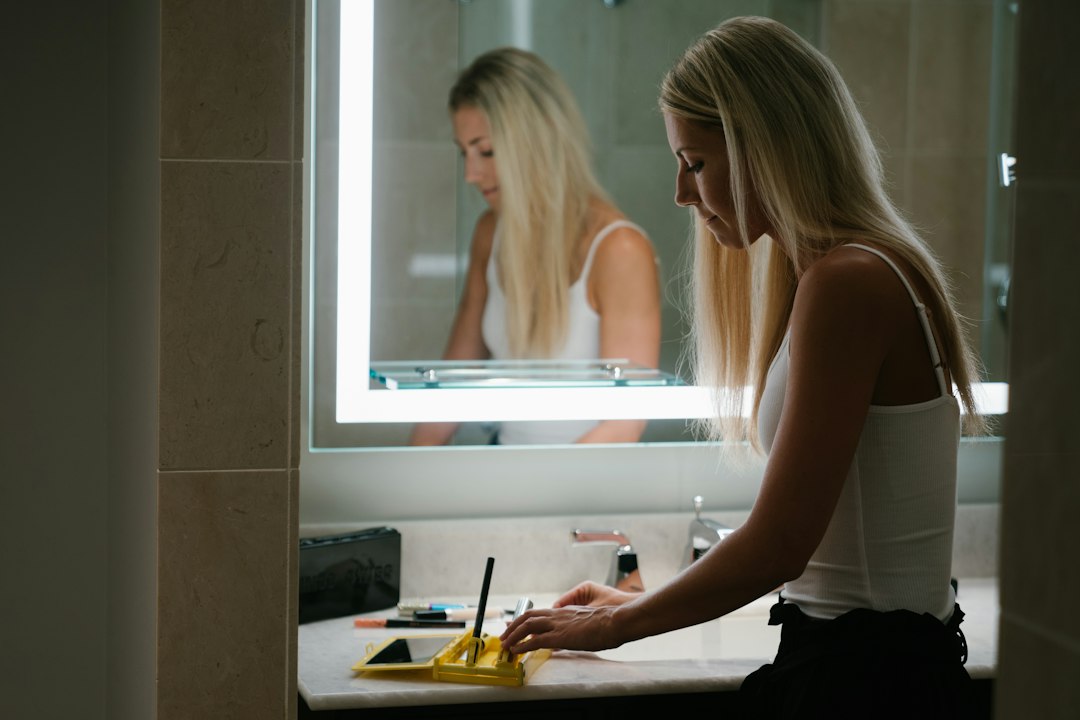
Finding the right light color temperature for your vanity mirror is key to flawless makeup application, and the short answer is that a range between 4000K and 5000K is generally considered ideal for natural, accurate representation. This range mimics daylight closely without being too warm or too cool, allowing you to see colors as they truly are and avoid unpleasant surprises once you step outside. It’s all about creating an environment where your makeup looks just as good in your mirror as it does under real-world conditions.
Understanding Color Temperature (CCT)
Color temperature, often abbreviated as CCT (Correlated Color Temperature), is a way to describe the appearance of light emitted by a light source. It’s measured in Kelvins (K) and isn’t about how hot the light physically is, but rather the color it appears to emit. Think of it like this: if you heat a piece of metal, it first glows red, then orange, then yellow, then white, and eventually a bluish-white as it gets hotter. The Kelvin scale mimics this, where lower numbers mean warmer, yellower light, and higher numbers mean cooler, bluer light.
The Kelvin Scale Demystified
The Kelvin scale starts at very low numbers, like 1000K, which is a very warm, reddish light similar to a candle flame. As the numbers increase, the light becomes progressively less orange and more yellow, then moves into a neutral white, and finally into cooler, bluer tones.
- Warm Light (2000K-3000K): This is your traditional incandescent bulb territory. It casts a cozy, yellowish-red glow. While pleasant for relaxation, it can make your skin look warmer than it actually is, leading to over-application of cool-toned makeup or foundation that looks too yellow once you step into natural light. It’s great for ambiance but not for accurate color rendering.
- Neutral White Light (3500K-4500K): This range is often referred to as “soft white” or “bright white.” It’s where the yellowish cast starts to diminish, and the light begins to appear more purely white. This is where we start getting into the sweet spot for makeup application because it’s a good approximation of indirect daylight.
- Cool White/Daylight (5000K-6500K+): At these higher Kelvin values, the light takes on a bluish tint. Think of a bright, overcast sky or the kind of light you might find in an office building or hospital. While it offers excellent clarity and detail, very high Kelvin lights can make you look washed out or emphasize cool undertones too much, potentially leading to over-correction with warmer makeup shades.
Why CCT Matters for Makeup
The human eye is incredibly adaptable, but that adaptability can be a disadvantage when it comes to makeup. Our brains constantly try to “correct” what we see, making colors appear consistent even under different lighting conditions. However, when applying makeup, you need to see the true colors of your products and your skin. If your vanity lighting is too warm, your foundation might look perfectly matched, but then appear too yellow or orange once you step into cooler daylight. Conversely, if your lighting is too cool, you might apply too much bronzer or blush to add warmth, only to look overly made-up under warmer lights. The goal is consistency and accuracy.
The Ideal CCT Range for Makeup
Based on extensive research and professional recommendations, the generally accepted ideal range for makeup lighting falls between 4000K and 5000K. This range strikes a perfect balance, mimicking natural daylight without being overly warm or cool.
The Sweet Spot: 4000K-5000K
Within this range, light appears crisp and clear, allowing you to accurately judge colors and textures.
- 4000K: This is a slightly warmer neutral white. It’s excellent if you live in an area with a lot of natural warm light or prefer a slightly softer, yet still accurate, look. It minimizes harsh shadows and provides a comfortable viewing experience while still offering good color accuracy. It’s a great choice for those who find higher Kelvin temperatures a bit too stark.
- 4500K: Often considered the “gold standard” by many makeup artists and professionals, 4500K light is a true neutral white. It provides excellent color rendering without any discernible yellow or blue tint. This is the closest you’ll get to a balanced, indirect daylight simulation, making it easy to match foundations, blend eyeshadows, and apply blush without guesswork.
- 5000K: This is the cooler end of the ideal spectrum, often referred to as “daylight white.” It’s very bright and clear, excellent for detailed work and seeing every nuance of your application. While some might find it a touch too cool for an everyday setting, it’s highly effective for meticulous makeup artists or those who want maximum clarity. It mimics bright, direct daylight very well.
Choosing within this 4000K-5000K range ensures that your makeup will look consistent whether you’re heading to an outdoor event, an office, or simply going about your day under natural light. It eliminates the guesswork and the potential for a “makeup surprise” later.
Why Not Lower or Higher?
Venturing outside this ideal range comes with drawbacks:
- Below 4000K (e.g., 2700K-3000K): These warm lights make everything look cozy and flattering but are detrimental to accurate makeup application. They add a yellow or orange cast to your skin, making you prone to applying too much foundation, concealer, or powder in an attempt to “correct” the artificial warmth. This often results in a face that looks too pale, gray, or uneven when viewed under natural light. They also obscure subtle color differences, making it difficult to choose the correct eyeshadow or blush shades.
- Above 5000K (e.g., 6000K-6500K): While these lights are incredibly bright and clear, they introduce a distinct blue tint. This can make your skin appear washed out, cool, or even sickly. In an attempt to counteract this perceived coolness, you might over-apply warm-toned products like bronzer or blush, leading to an overly ruddy or orange appearance in natural light. Furthermore, the starkness of very cool light can emphasize fine lines and imperfections more than necessary, which can be counterproductive to the goal of flattering makeup.
The goal is a balanced light that shows you exactly what you’re doing, not one that flatters you or makes you look worse, but one that simply shows the truth.
The Importance of CRI (Color Rendering Index)
While CCT tells you the color of the light, CRI (Color Rendering Index) tells you how accurately that light reveals the true colors of objects compared to natural sunlight. It’s a scale from 0 to 100, where 100 represents perfect color rendering. For makeup, a high CRI is just as crucial as the correct CCT.
What is CRI and Why it Matters
Imagine a red lipstick. Under a low CRI light, that lipstick might look muddy, dull, or even a different shade of red than it actually is. Under a high CRI light, that same lipstick will appear vibrant, true-to-color, and exactly as it was intended to look. This is because a high CRI light source is capable of rendering all colors in the visible spectrum faithfully.
For makeup, a low CRI light can lead to frustrating mistakes:
- Foundation Matching: It becomes nearly impossible to accurately match your foundation to your skin tone if the light isn’t rendering colors truly. You might pick a shade that looks perfect under a low CRI light, only to discover it’s too orange, pink, or gray once you step into natural light.
- Eyeshadow Blending: Subtle differences between similar eyeshadow shades can be completely lost under low CRI. Blending and creating dimension become much harder when you can’t see the true depth and vibrancy of your chosen colors.
- Blush and Bronzer Application: Judging the intensity and placement of these products relies heavily on seeing their true color. A low CRI light can make you apply too much or too little, or misjudge where to place it.
Recommended CRI for Makeup Lighting
For optimal makeup application, look for vanity mirror lights with a CRI of 90 or higher. Many high-quality LED bulbs designed for task lighting or photography will meet this standard. Some premium options even boast CRI ratings of 95 or 98. While a CRI of 80 is often considered acceptable for general household lighting, it’s simply not good enough for detailed tasks like makeup where color accuracy is paramount.
When shopping for lighting, always check both the CCT (Kelvin rating) and the CRI. Don’t assume a “daylight” bulb automatically has a high CRI; while many do, it’s not a given. A bulb advertising 4500K but a CRI of 70 will still distort colors, even if its color temperature is in the ideal range. Conversely, a bulb with a CRI of 95 but a CCT of 2700K will render colors accurately but bathe everything in a warm, yellowish glow that still isn’t ideal for makeup. You need both aspects working in harmony.
Practical Considerations for Vanity Lighting Setup
Beyond just the numbers, how you set up your lighting can significantly impact its effectiveness. Even with the perfect CCT and CRI, poor placement can create shadows and undermine your efforts.
Light Placement and Brightness
The goal is even, shadow-free illumination of your face.
- Around the Mirror: The most effective setup involves lights placed around the mirror, ideally on all sides (top and sides). This provides diffused, frontal illumination that minimizes harsh shadows. If full perimeter lighting isn’t possible, vertical strips on either side of the mirror are the next best option. This approach mimics professional studio lighting, ensuring your entire face is evenly lit from multiple angles.
- Avoid Overhead-Only Lighting: A single light source directly above you will cast harsh shadows under your brows, nose, and chin, making it difficult to blend properly and see true contours. This is a common mistake in bathrooms and leads to uneven makeup.
- Avoid Sconce-Only Lighting (if too far apart): If you only have sconces on either side of the mirror, ensure they are close enough to your face to provide adequate light without creating dark areas in the center of your face.
- Brightness (Lumens): While not a color property, brightness (measured in lumens) is also important. You need enough light to see clearly, but not so much that it’s blinding. For vanity lighting, a total output of around 1500-2000 lumens is generally a good starting point for a dedicated makeup area, distributed across multiple bulbs. Dimmable lights are a fantastic feature, allowing you to adjust the intensity based on time of day or specific needs.
Dimmable Lights and Multiple Light Sources
Having the ability to dim your vanity lights is incredibly useful. It allows you to:
- Adjust for Day vs. Night: You might prefer a slightly brighter setting for daytime makeup and a softer glow for evening touch-ups.
- Check Makeup in Different Conditions: While your primary setting should be your ideal CCT, dimmable lights can be useful for quickly checking how your makeup looks under lower light conditions, mimicking a restaurant or dimly lit room.
- Save Energy: Dimming lights when full brightness isn’t needed can conserve energy and extend bulb life.
Some advanced vanity mirror systems or light strips even offer adjustable CCT, allowing you to switch between warm, neutral, and cool tones. While the primary goal is to use the ideal neutral white for application, these features can be helpful for:
- Pre-checking: Before applying makeup, you could briefly switch to a warmer setting (like 2700K) to see how your skin naturally looks in cozy indoor lighting, or a cooler setting (like 6000K) to see how it appears under bright office lights. This isn’t for application, but for a quick “real-world check” after you’ve completed your look under the optimal neutral light.
- Targeting specific environments: If you know you’re going to be in a very specific lighting environment for an extended period, you could quickly check your makeup under a corresponding light. However, for actual application, stick to the 4000K-5000K range.
The key takeaway here is flexibility. While a single, ideal CCT is crucial, having dimmable options or even multi-CCT options can enhance your overall experience without detracting from the accuracy of your primary makeup application light.
Choosing the Right Bulbs or Mirror
Once you understand CCT and CRI, the next step is actually selecting the right products for your vanity setup. This involves choosing individual bulbs or investing in a specialized makeup mirror.
LED Bulbs: The Best Choice
LED (Light Emitting Diode) bulbs are hands down the best option for vanity lighting due to several advantages:
- Energy Efficiency: LEDs consume significantly less energy than incandescent or fluorescent bulbs, saving you money on electricity bills.
- Long Lifespan: LEDs last much longer, often tens of thousands of hours, meaning less frequent bulb changes.
- Minimal Heat Emission: Unlike incandescent bulbs, LEDs produce very little heat, which is a major comfort factor when you’re close to the light source applying makeup.
- Excellent Color Options: LEDs are readily available in a wide range of CCTs and can achieve very high CRI ratings. This makes it easy to find bulbs that meet the 4000K-5000K and CRI 90+ criteria.
When purchasing LED bulbs, always check the packaging for both the Kelvin (K) rating and the CRI (or Ra) value. Look for terms like “Daylight,” “Bright White,” or “Natural White” in combination with the specific Kelvin number. Avoid generic “Warm White” or “Cool White” unless they specifically list the Kelvin and CRI values that align with your needs.
Integrated LED Vanity Mirrors
Many modern vanity mirrors come with integrated LED lighting. These are often excellent choices because:
- Optimized Placement: The lights are typically designed to provide even illumination around the mirror, eliminating shadows.
- Specific Settings: Manufacturers often design these mirrors with makeup application in mind, so they frequently offer CCTs in the ideal 4000K-5000K range and high CRI values.
- Sleek Design: Integrated lighting creates a clean, minimalist look without the need for external fixtures.
- Additional Features: Many come with dimming capabilities, touch controls, magnification, and even anti-fog features.
When considering an integrated LED mirror, ensure you verify the CCT and CRI specifications before purchasing. Don’t assume that just because it’s a “makeup mirror” it automatically meets the highest standards. Reputable brands will clearly state these specifications.
Bulb Types to Avoid
- Incandescent Bulbs: While they have a perfect CRI of 100, their low CCT (typically 2700K-3000K) makes them too warm for accurate makeup application. They also generate a lot of heat and are energy inefficient.
- Compact Fluorescent Lamps (CFLs): CFLs can have decent CRI and CCT options, but they often have a slight flicker, can take time to reach full brightness, and contain mercury, making disposal more complicated. LEDs have largely superseded them.
- Halogen Bulbs: Halogen bulbs are essentially improved incandescent bulbs. They also have a CRI of 100 and can reach slightly higher CCTs (around 3200K-3500K), but they still emit significant heat and are not as energy-efficient as LEDs.
Ultimately, for the best combination of accuracy, efficiency, and comfort, high-CRI LED lighting in the 4000K-5000K range is the clear winner for your vanity.